

Table of Contents
- Why Your Coffee Tastes Bitter at Home
- Over-Extracted vs Under-Extracted Coffee: Know the Difference
- Coffee Grind Size Chart: Matching Grind to Brew Method
- Ideal Water Temperature for Coffee Brewing
- Coffee-to-Water Ratio, Brew Time, and Bloom
- Bean Freshness, Roast Level, and Flavor Profile
- Quick Fixes: Dairy, Alternatives, and Cleaning Your Equipment
- Conclusion
Last Updated: August 21, 2026
Why Your Coffee Tastes Bitter at Home
Bitter coffee almost always comes down to over-extraction: the brewing process has pulled too many compounds from the grounds, including harsh, high-molecular-weight molecules that dominate late in extraction. The good news is that over-extraction is preventable once you know which variables to adjust.
The Science of Over-Extraction
Over-extraction occurs when water dissolves too many soluble compounds from coffee grounds, pushing past desirable acids and sugars into bitter tannins and caffeine-adjacent compounds.
Extraction happens in sequence. Fruity acids and sugars dissolve first, contributing brightness and sweetness. Complex flavor compounds follow, providing body and depth. Last come bitter, astringent compounds, where home brewers get into trouble. A grind that is too fine, water that is too hot, or a brew time that runs too long all accelerate extraction and drag unwanted compounds into your cup. The result is a dry, coating mouthfeel with an unpleasant aftertaste that masks the coffee's natural character.
Over-Extracted vs Under-Extracted Coffee: Know the Difference
Most home brewers assume bitterness always means over-extraction, but this assumption gets them into trouble.
Over-extracted coffee tastes bitter, dry, and hollow with a harsh aftertaste that coats the back of the throat. The brew looks very dark and feels one-dimensional.
Under-extracted coffee tastes sour, sharp, and thin, lacking sweetness and body. It results from water moving through grounds too quickly, a grind that is too coarse, cool water, or a short brew time.
This distinction matters: if you add milk or sugar to mask what you think is bitterness but your coffee is actually under-extracted, you're covering up sourness, not solving it. The fix for each is opposite.
| Symptom | Likely Cause | Direction to Adjust |
|---|---|---|
| Harsh, dry, bitter | Over-extraction | Coarser grind, cooler water, shorter brew time |
| Sour, thin, sharp | Under-extraction | Finer grind, hotter water, longer brew time |
| Flat, no sweetness | Stale beans or wrong ratio | Fresher beans, adjust coffee-to-water ratio |
| Muddy, heavy sediment | Too fine a grind | Coarser grind, check filter |
Taste your coffee critically before adjusting anything. The fix depends entirely on which direction you've drifted.
Coffee Grind Size Chart: Matching Grind to Brew Method
Grind size is the single most controllable extraction variable. A grind that is too fine dramatically increases surface area exposed to water, accelerating extraction toward bitterness. A grind that is too coarse does the opposite.
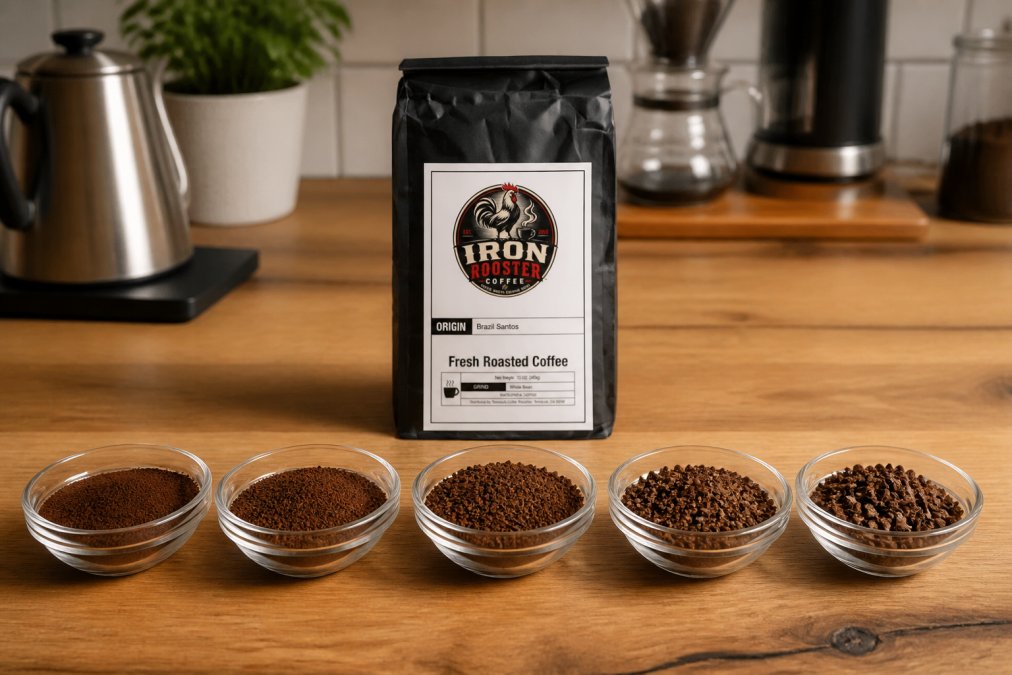
The right grind size depends on your brewing method. Immersion methods like French press keep grounds in contact with water for the full brew time, requiring a coarser grind to prevent over-extraction. Percolation methods like pour-over and drip move water continuously through grounds, requiring a medium grind. Espresso forces pressurized water through very fine grounds in seconds.
| Brew Method | Grind Size | Reference Texture |
|---|---|---|
| French Press | Extra coarse to coarse | Sea salt crystals |
| Cold Brew | Coarse | Rough sea salt |
| Pour-Over | Medium to medium-fine | Table salt |
| Drip Machine | Medium | Sand |
| AeroPress | Medium to fine | Granulated sugar |
| Espresso | Fine to extra fine | Powdered sugar |
| Moka Pot | Fine | Table salt (packed) |
A common mistake is using the same grind setting across multiple brewing methods. Switching from French press to pour-over without adjusting your grind will almost certainly produce bitter coffee.
Equipment-Specific Calibration Tips
Blade grinders are the biggest enemy of consistent extraction. They chop rather than grind, producing a mix of fine powder and large chunks that cause some grounds to over-extract while others under-extract. The fine sediment in your cup guarantees bitterness.
A burr grinder, whether flat or conical, produces uniform particle size and real extraction control. If you're still using a blade grinder and wondering why your coffee tastes bitter, that's likely the root cause.
For drip machines with built-in grinders, calibrate by running a test batch and tasting critically. If bitter, move one step coarser. If sour and thin, move one step finer. Adjust one variable at a time, changing grind and brew time simultaneously makes diagnosis impossible.
Ideal Water Temperature for Coffee Brewing
Water temperature is the second most impactful variable after grind size. Water that is too hot accelerates extraction aggressively, pulling bitter compounds. Water that is too cool under-extracts, leaving the cup sour and flat.
According to the Specialty Coffee Association's brewing standards, the ideal water temperature for most brewing methods falls between 195°F and 205°F (90°C to 96°C). Boiling water at 212°F is consistently too hot and is a common source of bitter coffee in home kitchens.
If you're using an electric kettle without temperature control, let boiling water sit for 30 to 45 seconds before pouring. That drop of 5 to 10 degrees makes a measurable difference in flavor, particularly with lighter roasts.
Dark roasts are more soluble than light roasts and extract faster at the same temperature. If brewing a dark roast produces bitterness, try dropping water temperature by 5°F before adjusting anything else.
Water Quality and Mineral Content
Mineral content in your water changes how temperature affects extraction. Hard water with high total dissolved solids carries more minerals that interact with coffee compounds during brewing.
As documented in the SCAA Water Quality Handbook, water with very low mineral content produces flat, lifeless coffee because minerals carry flavor compounds. Water that is too hard can amplify bitterness by reacting with certain acids.
The target range for brewing water is roughly 75 to 250 parts per million of total dissolved solids. If your tap water tastes strongly of chlorine or minerals, a simple carbon filtration pitcher can neutralize those compounds and meaningfully improve your cup.
Coffee-to-Water Ratio, Brew Time, and Bloom
The coffee-to-water ratio controls extraction strength. Too much coffee concentrates the brew and amplifies bitterness. Too little produces a weak, watery cup that may taste sour from under-extraction.
A widely used starting point is a 1:15 to 1:17 ratio by weight, one gram of coffee for every 15 to 17 grams of water. For a 12-ounce cup (roughly 355 grams of water), that means 21 to 24 grams of coffee. Measuring by weight rather than volume is more accurate.
Brew time determines how long water stays in contact with grounds. For pour-over methods, a total brew time of three to four minutes is reliable. French press typically runs four minutes before pressing. If your pour-over runs six or seven minutes, your grind is too fine and over-extraction is almost certain.
The bloom is the 30-to-45-second pre-infusion step where you pour just enough water to saturate the grounds. Blooming releases trapped carbon dioxide from fresh beans, preventing uneven agitation and channeling during the main brew. Channeling, where water finds a path of least resistance through grounds, leaves some areas over-extracted and others under-extracted, producing a muddled, bitter result.
Bean Freshness, Roast Level, and Flavor Profile
Stale beans directly cause bitter coffee. As coffee ages after roasting, volatile aromatic compounds that carry sweetness degrade, leaving behind more stable bitter compounds as the dominant flavor.
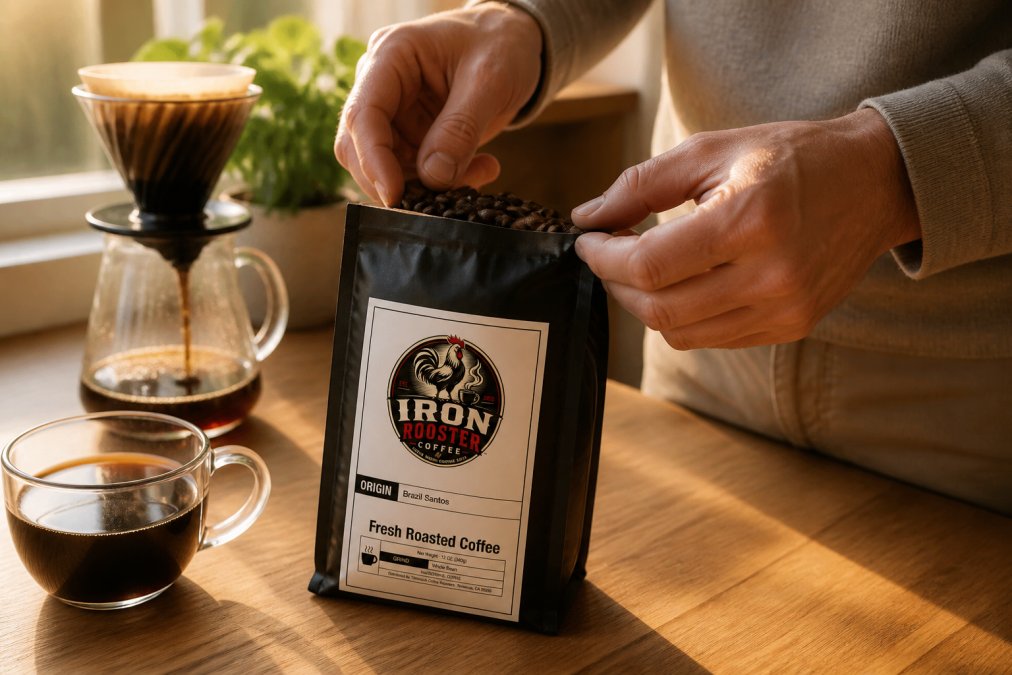
Freshly roasted beans, used within two to four weeks of the roast date, extract more evenly and produce a fuller, sweeter flavor profile. Beans without a roast date are almost guaranteed to produce a flatter, more bitter cup regardless of technique.
Roast level shapes the bitterness baseline. Dark roasts are inherently more bitter than light or medium roasts because the roasting process creates bitter compounds through the Maillard reaction and caramelization. This requires more careful extraction control to avoid harshness.
Iron Rooster Coffee Co.'s medium-roast single-origin offerings are a good starting point for home brewers reducing bitterness. The Brazil Santos produces an elegant, smooth cup with cocoa notes that are far more forgiving to extract than a dark roast. The Colombia and Peru single-origins offer similarly balanced profiles with dried orange and berry notes or salted caramel and citrus respectively, all at $20.99 per bag with freshly roasted beans shipped directly to your door.

Training Your Palate to Spot Bitterness Early
The real skill is catching bitterness at the margins, recognizing when a cup trends toward over-extraction before it becomes undrinkable.
Palate training starts with comparison tasting. Brew two identical batches with one variable changed: grind one step coarser or drop water temperature by 5°F. Taste them side by side without additives. The contrast makes extraction differences immediately obvious.
Pay attention to where you feel bitterness. Over-extraction bitterness sits at the back of the tongue and lingers in the aftertaste. Under-extraction sourness hits the sides of the tongue and dissipates quickly. Over time, this distinction becomes automatic.
Quick Fixes: Dairy, Alternatives, and Cleaning Your Equipment
Adding milk, cream, or a non-dairy alternative reduces perceived bitterness. Dairy fat coats the palate and interrupts bitter compounds' contact with taste receptors. This is why a latte tastes smoother than straight espresso even when over-extracted.
Non-dairy alternatives work similarly with different flavor interactions. Oat milk adds mild sweetness that complements medium roasts. Almond milk's lower fat content provides less bitterness reduction. These enhance an already well-extracted cup but don't rescue a fundamentally flawed one.
A small amount of salt (less than a quarter teaspoon per pot) can neutralize bitterness. As noted in food science research on taste suppression, sodium ions interfere with bitter taste signal transmission. It's not a myth, but it's not a substitute for fixing underlying extraction problems.
Cleaning your equipment matters more than most home brewers realize. Coffee oils left in a grinder, carafe, or brewing basket go rancid and add persistent bitter, stale flavor to every subsequent brew. Residue buildup in a drip machine's internal components is a common source of bitterness that doesn't respond to grind or temperature adjustment.
Rinse your brewing equipment after every use. Run a full cleaning cycle with dedicated coffee equipment cleaner monthly. Disassemble and brush your grinder every two weeks if you brew daily. These habits eliminate background bitterness that compounds over time.
| Fix | Best For | Limitation |
|---|---|---|
| Coarser grind | Over-extraction from grind | Requires burr grinder for precision |
| Lower water temp | Dark roast bitterness | Needs thermometer or temp-control kettle |
| Shorter brew time | Immersion method over-extraction | May under-extract if grind is too coarse |
| Filtered water | Mineral-driven bitterness | Doesn't fix extraction errors |
| Adding dairy | Immediate bitterness reduction | Masks, doesn't solve the problem |
| Equipment cleaning | Rancid oil bitterness | Ongoing maintenance required |
| Fresher beans | Stale-driven flatness and bitterness | Requires reliable fresh-roast source |
Bitter coffee at home is solvable by addressing the cause rather than covering it up. The most common culprits are a grind that is too fine, water that is too hot, and beans that are past their prime. Fix those three variables and most home brewers see immediate improvement.
If you want to start with beans that make the process easier, Iron Rooster Coffee Co.'s freshly roasted, carefully selected medium-roast single-origins give you a forgiving, naturally smooth flavor profile. With fast, automated fulfillment and beans shipped directly to your door, you're starting each brew with the freshest possible foundation. Add the Peru Decaf for evenings or the Colombia for a brighter morning cup. Get started with Iron Rooster Coffee Co. and brew a cup you actually look forward to.

Frequently Asked Questions
Why is my coffee at home always bitter?
Bitter coffee at home almost always comes down to over-extraction, meaning too many bitter compounds were pulled from the grounds. The most common causes are a grind that is too fine, water that is too hot, or a brew time that runs too long. Stale beans and a dirty brewer also contribute. Fixing one variable at a time, starting with grind size, usually resolves the problem within a few test brews.
Does grind size affect coffee bitterness?
Yes, grind size is one of the biggest factors controlling bitterness. A finer grind increases the surface area exposed to water, which speeds up extraction and pulls bitter tannins and other harsh compounds into your cup. If your coffee tastes bitter, try going one step coarser on your grinder. For drip machines, medium grind is the standard starting point. Small adjustments make a noticeable difference in the final flavor profile.
What kind of coffee is best for people who don't like bitter coffee?
Medium-roast, single-origin beans tend to produce the smoothest, least bitter cups. Dark roasts develop more bitter compounds during the roasting process, while medium roasts preserve the bean's natural sweetness and acidity. Single-origin coffees from regions like Peru or Colombia often offer caramel, fruit, and chocolate notes with minimal harshness. Freshness also matters: beans roasted within the last two to four weeks extract more cleanly than older, stale stock.
What cancels out bitterness in coffee?
A small pinch of salt (about one-eighth of a teaspoon per 12 ounces) can neutralize perceived bitterness without adding a salty flavor. Adding dairy or a non-dairy alternative like oat milk softens bitterness by coating the palate and diluting harsh compounds. These are useful short-term fixes, but the real solution is adjusting your grind size, water temperature, or brew time so the bitterness never enters the cup in the first place.
This article was written using GrandRanker