

Table of Contents
- How We Selected the Best Artisan Coffee for Home Brewing
-
Top Artisan Coffee Picks for Home Brewing
- Brazil Santos: Smooth, Cocoa-Forward Single-Origin
- Colombia: Balanced Berry and Chocolate Notes
- Ethiopia Natural: Fruity and Floral Character
- Guatemala: Dark Chocolate with Bright Fruit
- Kenya: High-Acidity Citrus and Floral Profile
- Sumatra: Full-Bodied and Earthy
- House Blend: Consistent, Versatile Everyday Option
- Understanding Roast Profiles and Flavor Development
- Coffee Grind Size Guide for Home Brewing
- Cold Brew vs Iced Coffee Flavor Profile
- How to Store Artisan Coffee Beans for Maximum Freshness
- Brewing Methods That Highlight Artisan Coffee Quality
- What Makes Artisan Coffee Worth the Investment
Last Updated: August 26, 2026
How We Selected the Best Artisan Coffee for Home Brewing
Finding the best artisan coffee for home brewing means understanding what separates craft roasters from commodity producers. At Iron Rooster Coffee Co., we prioritize freshness, sourcing transparency, and flavor consistency, the three pillars that transform your morning cup from ordinary to exceptional.

Our selection process tested each coffee across multiple brewing methods: drip, pour-over, French press, and cold brew, evaluating extraction clarity, body consistency, and how tasting notes held up across different water temperatures and grind sizes. What matters most is whether the beans arrive fresh with recent roast dates and transparent sourcing details traceable to the farm.
Top Artisan Coffee Picks for Home Brewing
The best artisan coffee for home brewing balances accessibility with complexity. Whether you're seeking a daily driver or exploring single-origin profiles, these options deliver consistent quality and genuine flavor development.
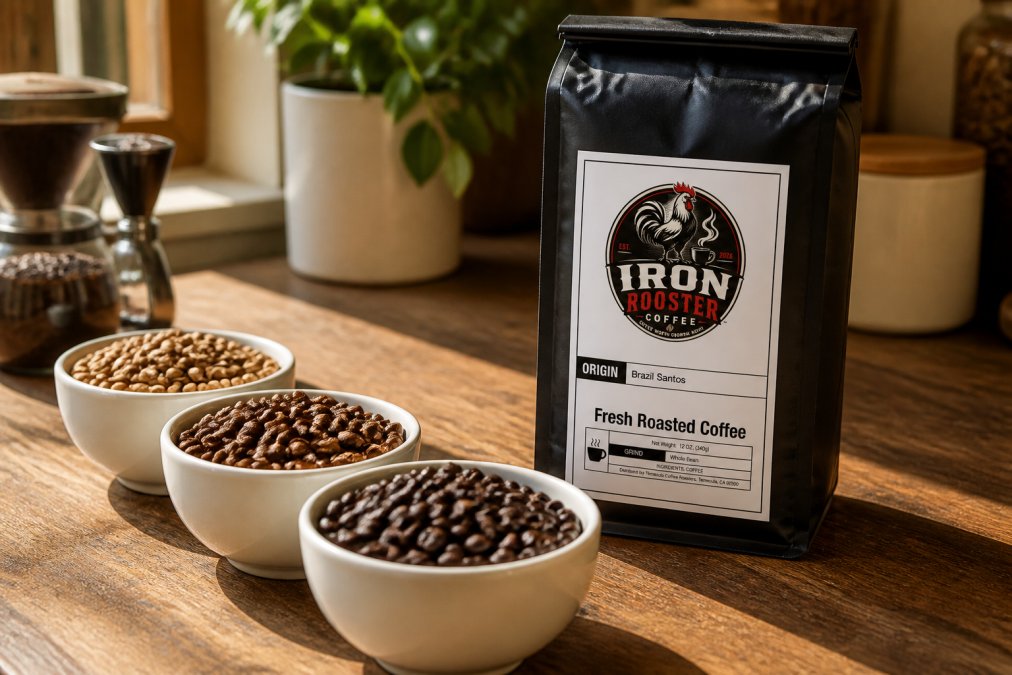
Brazil Santos: Smooth, Cocoa-Forward Single-Origin
This medium roast from Iron Rooster Coffee Co. ($20.99) delivers an elegant, smooth cup with pronounced cocoa notes and a clean finish. The beans come from Fazenda Santa Barbara in São Francisco, grown at 750-1050 meters on volcanic loam soil using pulped natural and sun-dried processing.
The processing method preserves sweetness while avoiding over-extraction bitterness. The Catuai and Mundo Novo varieties contribute body without heaviness. Brew it as drip coffee or pour-over, and the cocoa notes remain consistent across different grind sizes. The mouthfeel stays smooth even when the coffee cools.
Colombia: Balanced Berry and Chocolate Notes
This medium roast from Iron Rooster Coffee Co. ($20.99) brings balance to your cup. Sourced from smallholder farmers in Medellin at 1300-1500 meters, it combines dried orange, berry, and chocolate tasting notes. The volcanic loam soil and fully washed processing create clarity where you taste each note distinctly.

The Castillo, Caturra, Colombia, and Typica varieties produce medium body and clean acidity. Pour-over extraction emphasizes the berry notes while French press brings out chocolate and orange. The solar drying process protects the beans from rain damage, ensuring consistency batch to batch.
Ethiopia Natural: Fruity and Floral Character
This medium-light roast from Iron Rooster Coffee Co. ($20.99) showcases milk chocolate, fruity, and caramel notes from indigenous heirloom cultivars grown in the Sidama zone at 1700-1900 meters. The natural processing creates the fruity character that defines Ethiopian coffees.

Hand-sorted beans and raised-bed drying mean premium preparation at every stage. The higher altitude produces complex sugars that develop into caramel notes in the finish. Pour-over or AeroPress work best because they allow you to control water temperature and contact time, bringing out floral complexity without over-extraction.
Guatemala: Dark Chocolate with Bright Fruit
This medium roast from Iron Rooster Coffee Co. ($20.99) walks the line between bold and bright. Grown in Antigua at 1200-1616 meters on volcanic loam, the Bourbon, Catuai, Caturra, and Typica varieties produce dark chocolate and butterscotch notes with surprising citrus brightness. The fully washed and sun-dried processing creates clean acidity without harshness.
The volcanic loam adds mineral notes that complement the chocolate and fruit. Guatemala handles higher coffee-to-water ratios without becoming muddy. This coffee excels in French press, where immersion brewing extracts the full body and chocolate character.
Kenya: High-Acidity Citrus and Floral Profile
This single-origin from Iron Rooster Coffee Co. ($20.99) delivers bright acidity with orange, lemon, and floral notes. Grown in Othaya, Nyeri County at 1700-1890 meters, the SL28, SL34, Ruiru 11, and Batian varieties are fully washed and dried on raised beds, emphasizing clarity and complexity.
The high altitude and specific varietals create the effervescent quality Kenyan coffees are known for. The acidity is bright and energizing, more like lemon zest than vinegar. Pour-over brewing highlights the floral notes beautifully.
Sumatra: Full-Bodied and Earthy
This single-origin from Iron Rooster Coffee Co. ($20.99) uses wet-hulling (Giling Basha), a method that creates medium acidity, syrupy body, dark chocolate, dried fruit, and earthy notes. Grown in Aceh at 1100-1600 meters by the Koperasi Baitul Qiradh Baburrayyan cooperative, the Tim Tim, Typica, Ateng, Onan Ganjang, and Jember varieties produce a distinctive coffee unlike anything from Central America or Africa.
The wet-hulling process removes the parchment layer while the bean still contains moisture, creating the distinctive earthy, full-bodied character. French press is the ideal brewing method, extracting the full body without the brightness that pour-over would emphasize.
House Blend: Consistent, Versatile Everyday Option
The House Blend from Iron Rooster Coffee Co. ($20.99) is a reliable, approachable medium roast combining select coffees from Central and South America into a smooth, clean, and consistent cup. The tasting notes include nutty, sweet chocolate, mild citrus, and a clean bright finish.
The blend uses both natural and washed processing methods, adding complexity without confusion. The medium body sits in the sweet spot, substantial enough to feel satisfying yet light enough for multiple cups. This coffee performs well across all brewing methods.
Understanding Roast Profiles and Flavor Development
Roast profile determines how the coffee's inherent qualities express themselves in your cup. Light roasts preserve origin characteristics; medium roasts balance origin flavor with roast-induced sweetness; dark roasts emphasize body and reduce acidity.
The coffees featured here range from medium-light (Ethiopia Natural) to medium, with none pushed to dark roast, which would obscure the origin character. Roast dates are recent, ideally within two weeks of purchase, because roasted coffee begins losing volatile aromatics immediately after roasting.
A light roast requires slightly cooler water (195-200°F) to avoid over-extraction (peer-reviewed research). A medium roast handles standard 200-205°F water. Lighter roasts typically need slightly finer grinds to extract properly, while darker roasts can use coarser grinds without becoming sour.
Coffee Grind Size Guide for Home Brewing
Grind consistency determines extraction rate and flavor outcome. Too coarse, and the water passes through without extracting enough soluble compounds. Too fine, and over-extraction creates bitterness. The target is the sweet spot where extraction pulls out sweetness, acidity, and body in balance.
For drip coffee machines, use a medium grind (sand texture). Pour-over typically uses medium-fine grind because contact time is shorter. French press uses coarse grind because immersion brewing extracts more efficiently.
| Brewing Method | Grind Size | Consistency | Contact Time |
|---|---|---|---|
| Automatic Drip | Medium | Sand texture | 4-6 minutes |
| Pour-Over | Medium-Fine | Fine sand | 2-3 minutes |
| French Press | Coarse | Breadcrumb texture | 4 minutes |
| AeroPress | Medium-Fine | Fine sand | 1-2 minutes |
| Espresso | Fine | Powdery | 25-30 seconds |
| Cold Brew | Coarse | Breadcrumb texture | 12-24 hours |
Invest in a burr grinder, not a blade grinder. Burr grinders produce uniform particle size for even extraction. Blade grinders create inconsistent sizes, leading to uneven extraction and muddy flavor.
Cold Brew vs Iced Coffee Flavor Profile
Cold brew steeps coarse grounds in room-temperature water for 12-24 hours, creating a smooth, naturally sweet, low-acidity concentrate. Iced coffee is hot-brewed coffee poured over ice, which cools it rapidly but doesn't change the extraction chemistry.
Cold brew extracts more slowly because water temperature is lower, pulling fewer harsh compounds. The long contact time compensates for the low temperature, creating a full-bodied concentrate. Iced coffee undergoes standard hot-water extraction, then gets cooled, the extraction chemistry is identical to hot coffee.
For artisan coffee, cold brew is the revelation. Single-origin coffees that might taste bright or acidic when hot often become smooth and naturally sweet when cold-brewed. Kenya cold brew loses harsh edges while maintaining citrus character. Ethiopia natural cold brew emphasizes chocolate and caramel over floral notes.
Use a coarse grind and a 1:4 coffee-to-water ratio. Steep for 16-18 hours at room temperature, then strain through fine mesh or cheesecloth. Dilute the concentrate with water or milk when serving.
How to Store Artisan Coffee Beans for Maximum Freshness
Coffee begins losing aromatics the moment it's roasted. After two weeks, noticeable degradation starts (peer-reviewed research). After four weeks, most coffees taste flat and stale.
Store beans in an airtight container away from light, heat, and moisture. Oxygen exposure causes oxidation, which degrades flavor compounds. Light accelerates this process. Heat speeds up off-gassing, which releases the aromatic compounds you want in your cup.
The ideal storage container is opaque and airtight, such as a small glass jar with a tight lid or a specialized coffee canister with a one-way valve. Avoid clear containers and the freezer. Room temperature in a dark cabinet works best.
Buy whole beans, not pre-ground. Ground coffee has exponentially more surface area exposed to oxygen, so it stales faster. Grind immediately before brewing. Properly stored beans in an airtight container stay fresh for 3-4 weeks.
Brewing Methods That Highlight Artisan Coffee Quality
Different brewing methods extract different flavor compounds, which is why the same coffee tastes noticeably different in a drip machine versus a French press.
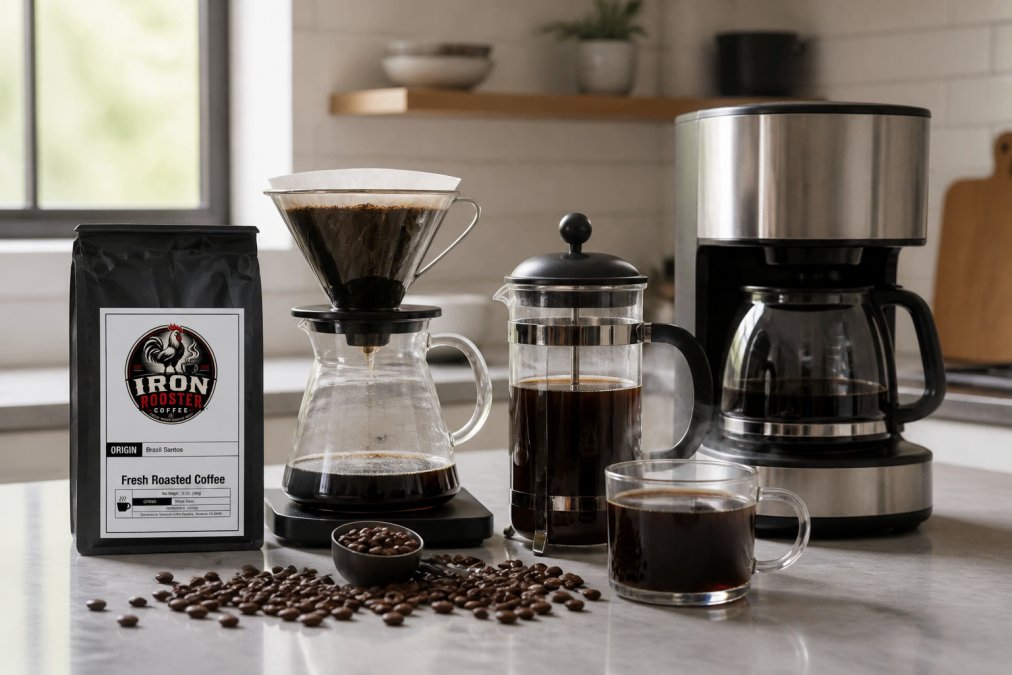
Pour-over brewing creates clarity. The water passes through a paper or metal filter, removing oils and sediment. This produces a clean cup where individual flavor notes stand out distinctly. Single-origin coffees with complex tasting profiles, like Kenya, Ethiopia, and Colombia, shine in pour-over.
French press immersion brewing emphasizes body. The grounds steep in hot water for four minutes, extracting more oils and suspended solids. This creates fuller mouthfeel and brings out sweetness. Sumatra and Guatemala perform beautifully in French press because the method highlights their body and chocolate notes.
Automatic drip machines are the middle ground, consistent and forgiving. They work well with the House Blend or Brazil Santos, coffees designed for everyday brewing.
AeroPress brewing is precise and produces a clean cup similar to pour-over but with slightly more body. It's ideal for experimentation because you can adjust water temperature, grind size, and steep time easily.
Cold brew transforms acidic coffees into smooth, naturally sweet beverages. Water chemistry matters more than most home brewers realize. Mineral content affects extraction efficiency. Filtered tap water or bottled water with moderate mineral content (50-150 ppm) works best (peer-reviewed research).
What Makes Artisan Coffee Worth the Investment
Artisan coffee costs more than grocery store options because mass-market coffee is often a blend of lower-grade beans, sometimes including robusta (a species with twice the caffeine but half the flavor complexity of arabica). These coffees are roasted dark to mask defects and inconsistency.
Artisan coffee focuses on single-origin arabica beans, careful sourcing from specific farms or cooperatives, and roasting that preserves origin character. The beans are fresher, roasted weeks ago, not months. The roaster knows the farm, altitude, processing method, and expected flavor profile. This transparency and care costs more but produces a genuinely different cup.
Iron Rooster Coffee Co.'s artisan options ($19.99-$20.99 per bag) arrive fresher than specialty coffee from grocery stores with full traceability. For remote professionals and home workers drinking coffee multiple times daily, the quality improvement justifies the cost. A smooth, flavorful cup costs a few cents more per serving than bitter, stale commodity coffee.
Direct-to-door delivery means you're never stuck with stale beans. Subscription or one-time orders arrive fresh, ensuring consistency and knowing your coffee will taste good every morning.
Choosing the best artisan coffee for home brewing comes down to three decisions: freshness, sourcing transparency, and brewing method alignment. Iron Rooster Coffee Co. handles the first two by roasting to order and providing full farm details. You handle the third by understanding which brewing method highlights the coffee's best qualities.
Start with Brazil Santos or the House Blend if you want a smooth, forgiving everyday option. Move to Colombia or Guatemala if you're ready for more complexity. Explore Kenya or Ethiopia when you want to experience how altitude and processing transform flavor. Every bag is designed to deliver the smooth, flavorful experience that makes mornings better. Get started with Iron Rooster Coffee Co. and discover how fresh, carefully sourced artisan coffee changes your daily routine.
Frequently Asked Questions
What makes artisan coffee different from mass-market grocery store coffee?
Artisan coffee is freshly roasted in small batches and sourced from specific origins, emphasizing distinct flavor profiles and processing methods. Mass-market coffee is often roasted weeks or months before purchase and blended from multiple sources for consistency rather than character. Artisan roasters focus on terroir, altitude, and processing technique, factors that create complexity in the cup. The roast date matters significantly; artisan coffee maintains peak freshness for 2-4 weeks after roasting, while grocery store coffee loses vibrancy over months of storage.
How do I choose between single-origin and blended artisan coffee?
Single-origin coffees showcase the unique characteristics of one region's beans, offering distinct tasting notes tied to altitude, soil, and processing. They're ideal for exploring flavor diversity and understanding how geography shapes coffee. Blended artisan coffees combine beans from different origins to create balanced, consistent profiles, perfect for everyday brewing or if you prefer a smooth, mellow cup without bold acidity. For home brewing, try single-origins when you want to taste specific flavor notes, and choose blends when you prioritize consistency and smoothness across your morning routine.
Does grind consistency really matter for brewing artisan coffee?
Yes. Grind size directly affects extraction, how quickly water pulls flavors from the beans. Too coarse, and you'll get weak, sour coffee; too fine, and over-extraction creates bitterness. Artisan coffee's complex flavor profile is only achieved with proper grind consistency matched to your brewing method. Drip coffee requires medium grind, pour-over needs medium-fine, and French press works with coarse. Investing in a burr grinder (not blade) ensures uniform particle size, which is essential for unlocking the nuanced tasting notes that make artisan coffee worth buying.
How fresh does artisan coffee need to be when I order it?
Artisan coffee is best consumed within 2-4 weeks of the roast date. Freshly roasted beans are still releasing CO2 (degassing) during the first 5-7 days, so brewing immediately after roasting can result in uneven extraction. The sweet spot is 1-2 weeks post-roast. After 4 weeks, the beans begin losing their bright, nuanced flavors and become stale. Always check the roast date on your bag before brewing, and store beans in an airtight container away from heat, light, and moisture to preserve freshness throughout their usable window.
This article was written using GrandRanker