

Table of Contents
- Why Fresh Roasted Coffee Behaves Differently at the Grinder
- How Grind Size Affects Extraction in Fresh Roasted Coffee
- Grind Size Chart by Brew Method
- Matching Grind Size to Roast Level
- How to Store Fresh Roasted Coffee Without Wrecking Your Grind Settings
- How to Order Fresh Roasted Beans Online (and What to Check First)
- Common Grind Mistakes and How to Fix Them
- Conclusion
- Frequently Asked Questions
Last Updated: September 17, 2026
Why Fresh Roasted Coffee Behaves Differently at the Grinder
Fresh roasted coffee is coffee that has finished roasting within roughly the past two to three weeks, and it does not grind like the bagged coffee sitting on a grocery shelf. This guide from Iron Rooster Coffee Co. explains the best grind size for fresh roasted coffee, because beans still releasing carbon dioxide resist water in ways older beans do not.
Degassing is the process by which roasted beans release trapped carbon dioxide over the days after roasting. That gas pushes back against water during brewing, so a grind that worked perfectly on a three-month-old bean will taste thin and sour on a five-day-old one. Grind size is the diameter of an individual coffee particle, measured in microns, and it is the fastest variable to adjust when a cup tastes wrong.
How Grind Size Affects Extraction in Fresh Roasted Coffee
Grind size controls how much surface area water can reach, and surface area controls extraction yield, the percentage of the bean's mass that dissolves into your cup. Finer particles expose more surface area and extract faster. Coarser particles expose less and extract slower.
Under-Extraction vs. Over-Extraction: What You Taste
Under-extraction happens when water moves through the coffee too quickly to dissolve the sugars and caramelized compounds, tasting sour, sharp, and thin with a salty finish. Over-extraction happens when water stays in contact too long and pulls out bitter, dry, woody compounds, tasting harsh, astringent, and drying.
For fresh beans, the trap is under-extraction: escaping carbon dioxide repels water, so the same grind that tasted balanced on a two-month-old bag now tastes sour. Tighten the grind roughly one or two clicks finer on a stepped grinder and taste again.
Why Degassing Changes Your First Week of Brewing
A fresh roast changes character daily for its first week. On day two, a bean may still hold enough gas that your normal grind runs fast and tastes hollow. By day ten, that gas is largely gone and the identical setting pulls a slower, sweeter shot.
The practical fix is to grind finer early and relax the setting as the bag ages.
Grind Size Chart by Brew Method
Every brew method has a target grind range, and starting inside it saves you from chasing flavor problems that are really grind problems.
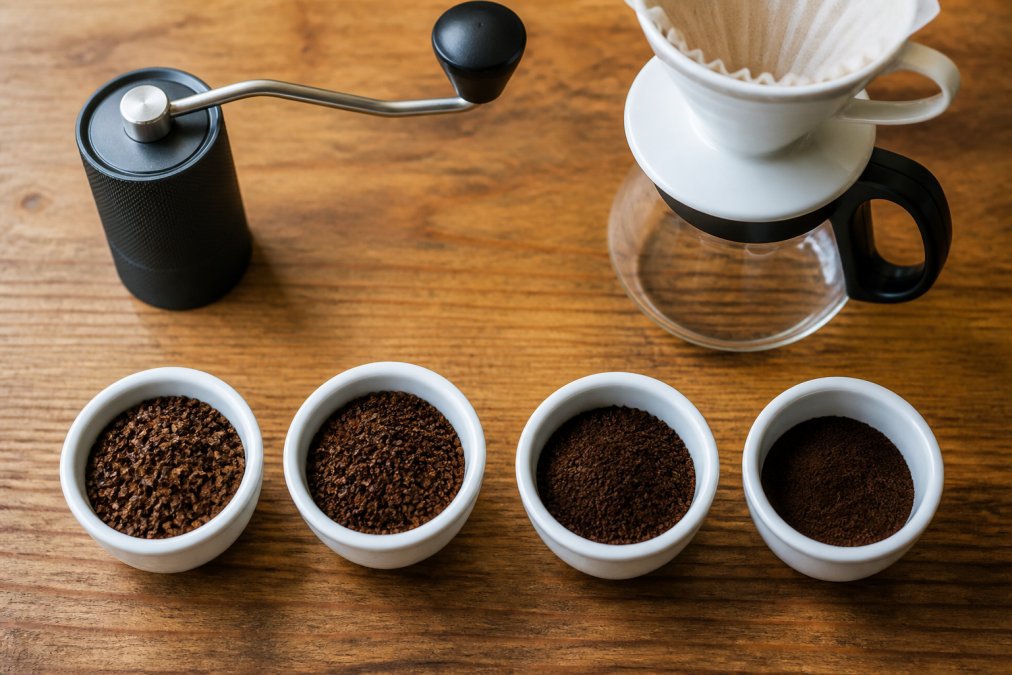
| Brew Method | Grind Size | Texture Reference | Typical Contact Time |
|---|---|---|---|
| French press | Coarse | Sea salt | 4-5 minutes |
| Drip coffee | Medium | Table salt | 4-6 minutes |
| Pour-over | Medium-fine | Fine sand | 2.5-3.5 minutes |
| Espresso | Fine | Powdered sugar | 25-30 seconds |
| Moka pot | Fine-medium | Fine sand, slightly coarser | 2-3 minutes |
Matching Grind Size to Roast Level
Roast level changes bean density, and density changes how a bean fractures in the grinder. Light roast beans are denser and hold more moisture, so they resist the burrs longer and shatter into a wider spread of particle sizes, usually needing a finer grind to extract fully. Dark roast beans are more porous and brittle, break into more fines (dusty particles under 100 microns), and extract quickly, so they typically want a coarser setting.
Why Burr Type Changes the Setting You Land On
The same roast level does not produce the same particle distribution on every grinder, because flat burrs and conical burrs cut coffee differently.
- Flat burrs grind between two parallel rings and tend to produce a narrower, more uniform particle size distribution with fewer extremes. That uniformity makes fresh-bean dialing more predictable: when you move one step finer, the whole bed shifts together.
- Conical burrs feed beans down a cone and out through a ring, producing a slightly wider distribution with more fines and more boulders in the same dose. The fines can help body and sweetness, but they also make fresh beans fussier, because the boulders under-extract while the fines over-extract in the same shot.
Reading the Grind by Hand and Eye
Before you trust a chart, learn what your target looks and feels like. Texture references beyond "sea salt" help:
Best Sellers Sample Pack: 6Bean →
| Grind | Looks Like | Feels Like Between Fingers |
|---|---|---|
| Coarse | Rough, distinct flakes, like cracked peppercorns | Gritty, individual pieces roll apart |
| Medium | Even grains, like coarse sand | Slightly gritty, holds a loose clump |
| Medium-fine | Fine sand, few visible flakes | Smooth with light grit, clumps when pinched |
| Fine | Powder with a faint grain, like powdered sugar | Smooth, clumps and holds a fingerprint |
Mapping Your Grinder Across Roast Levels
This is where a sample pack earns its keep. Ordering a range of roast levels and brewing each at the same setting shows you how much your grinder needs to move between a light Ethiopian and a dark blend. The Best Sellers Sample Pack: 6Bean, Cowboy, Breakfast, Peru, Mexico, Bali at $22.99 puts a dark house blend, a medium breakfast blend, and three medium single origins side by side, enough variety to map your grinder's behavior across roast levels.

How to Store Fresh Roasted Coffee Without Wrecking Your Grind Settings
Storage and grind size are linked more tightly than most people realize, because oxygen and moisture both change how a bean fractures. Coffee stored in an open bag or clear canister stales fast, and stale beans grind differently, so your carefully dialed setting drifts without you touching the grinder.
How to Order Fresh Roasted Beans Online (and What to Check First)
Buying fresh roasted beans online comes down to three checks, and skipping them is why so many people end up with coffee that tastes flat on arrival.
- Look for a roast date, not a best-by date. A printed roast date tells you exactly how old the coffee is. A best-by date tells you nothing useful.
- Check the roast-to-ship window. A roaster who ships within a day or two of roasting gets you beans at peak flavor. A roaster who ships from a warehouse may not.
- Confirm the bag has a one-way degassing valve. This small valve lets carbon dioxide escape without letting oxygen in, which keeps the coffee fresher in transit.
Common Grind Mistakes and How to Fix Them
Most grind problems trace to a handful of causes, each with a straightforward fix. The first four are the ones every guide lists; the last three are the ones that actually bite people brewing fresh beans.
| Mistake | What It Tastes Like | The Fix |
|---|---|---|
| Grinding too coarse for fresh beans | Sour, thin, watery | Go one or two clicks finer |
| Grinding too fine for the brew time | Bitter, harsh, drying | Go coarser and shorten contact time |
| Using a blade grinder | Inconsistent, muddy, unpredictable | Switch to a burr grinder |
| Grinding days ahead | Flat, lifeless, stale | Grind immediately before brewing |
The Freshness Mistakes Nobody Warns You About
These three are specific to fresh roasted coffee, and they explain why a setting that worked yesterday tastes wrong today even though you changed nothing.
Conclusion
Fresh roasted coffee asks more of your grinder than shelf-stable beans do, because degassing, roast level, and bean density all shift the setting that works. Start finer than the standard chart suggests, adjust as the bag ages, and grind right before you brew.
Frequently Asked Questions
What is the perfect grind size for fresh roasted coffee?
There is no single number, because grind size has to match your brew method and how fresh the beans are. A pour-over typically wants a medium grind, a French press needs coarse, and espresso needs fine. Fresh roasted coffee also releases carbon dioxide for several days after roasting, which slows water flow. If your usual setting tastes weak or sour in the first week, grind one step finer and taste again.
Do darker roasts need a finer grind?
They usually need a coarser one. Dark roasts spend more time in the roaster, so the bean structure is more porous and soluble. That means water pulls flavor out faster, and a fine grind can push the cup into bitterness. If you switch from a medium roast to a dark roast at the same setting, expect to grind coarser. The reverse applies for light roasts, which often need a finer grind to extract fully.
Can the wrong grind size make fresh coffee taste bitter or sour?
Yes, and the direction tells you what to change. Sour, sharp, or thin coffee usually means under-extraction, so grind finer or extend contact time. Bitter, dry, or hollow coffee usually means over-extraction, so grind coarser. Change one variable at a time and taste after each adjustment. A medium roast like Brazil Santos, with its smooth cocoa notes, makes a forgiving starting point while you dial in.
How long should I wait after roasting before grinding?
Most coffee tastes best between four and fourteen days after the roast date. In the first two or three days, heavy degassing disrupts water flow and can make even a correct grind taste flat. If you brew immediately after delivery, grind slightly finer than your normal setting and expect the cup to improve through the week. Store beans in an airtight container away from light and heat, and grind right before brewing.