

Table of Contents
- Fresh Roasted Coffee vs Grocery Store: Key Differences at a Glance
- Understanding Coffee Roast Date Importance
- Flavor Profile and Quality: What Changes After Roasting
- How to Store Coffee Beans for Maximum Freshness
- Signs of Stale Coffee Beans and What to Avoid
- Cost Analysis: Price Per Cup and What You're Actually Paying For
- Sourcing, Supply Chain, and Bean Quality Standards
- Which Option Is Right for You
Last Updated: August 25, 2026
Fresh Roasted Coffee vs Grocery Store: Key Differences at a Glance
The difference between fresh roasted coffee and grocery store coffee is chemistry. Within days of roasting, coffee loses volatile compounds that create complexity, brightness, and depth. Grocery store coffee has often sat in warehouses for months, oxidizing into a flat, bitter version of what it once was. At Iron Rooster Coffee Co., we've analyzed what separates a cup that tastes alive from one that tastes tired: roast date, storage, and supply chain.
Understanding Coffee Roast Date Importance
The roast date is the single most important indicator of coffee quality. Fresh roasted coffee reaches its peak flavor window between 5 and 7 days after roasting, when degassing has progressed enough for clean brewing but volatile aromatic compounds haven't yet oxidized away (peer-reviewed research).
Grocery store coffee rarely displays a roast date. Instead, you'll see a "best by" date 12-18 months away, a legal shelf-life marker, not a roast indicator. The coffee was likely roasted 2 to 6 months before you bought it. By then, oxidation has flattened the flavor profile, turning bright acidity into harshness and complex notes into bitterness.
The moment heat stops, chemical breakdown begins. Oxygen enters the bean structure through microscopic cracks created during roasting. Delicate esters and aldehydes responsible for fruity, floral, and nuanced flavors break down into simpler, harsher compounds. This process accelerates with heat, light, and air exposure, exactly the conditions in most grocery store warehouses and retail shelves.
Flavor Profile and Quality: What Changes After Roasting
The flavor of coffee is determined by hundreds of compounds created during roasting and preserved, or destroyed, during storage. Fresh roasted coffee has a bright, complex flavor profile because those compounds are still stable. Grocery store coffee tastes flat, bitter, or one-dimensional because oxidation has simplified the chemistry.
During roasting, heat creates new flavor compounds through the Maillard reaction and caramelization, including fruity esters, floral aldehydes, and complex organic acids that create "brightness" or "acidity." Fresh roasted coffee from specialty roasters like Iron Rooster Coffee Co. is roasted to order or within days of shipment, delivering beans at their peak when extraction is clean and flavor notes are distinct. A single-origin coffee might taste like dark chocolate and molasses or smooth cocoa with citrus brightness.
Grocery store coffee has already entered flavor decay. Bright acidity has oxidized into harsh, astringent bitterness. Complex notes have flattened into one-note, burnt taste.
The Bloom and Degassing Process
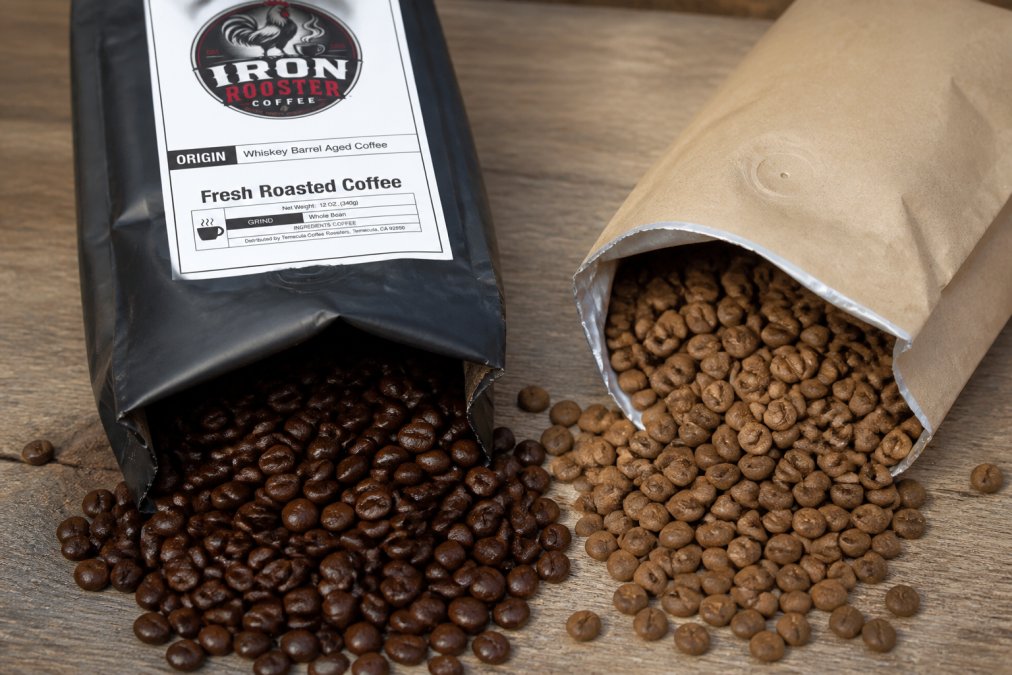
When you pour hot water over fresh roasted coffee, you see an immediate, vigorous bloom, a foamy layer that releases aroma. This bloom is carbon dioxide escaping from the bean structure. Fresh beans have trapped CO2, which affects extraction.
Degassing happens naturally after roasting. By day 3-5, degassing has slowed enough for clean, even extraction. By day 14, most CO2 is gone. The sweet spot is that 5-7 day window when degassing is mostly complete but beans still have enough CO2 for proper water distribution.
Grocery store coffee has been degassing for weeks or months. The bloom is minimal or nonexistent, resulting in inconsistent extraction and a cup that tastes muddled or bitter.
Oxidation and Flavor Decay Over Time
Oxidation is the enemy of fresh coffee. Once roasting stops, oxygen begins attacking flavor compounds. This process accelerates with exposure to light, heat, and air.
Fresh roasted coffee is sealed in valve-sealed bags that allow CO2 to escape while blocking oxygen from entering. Combined with quick shipping and cool, dark storage, oxidation stays minimal for 3-4 weeks.
Grocery store coffee sits in warehouses, distribution centers, and retail shelves for months. Even in sealed bags, oxidation continues. By purchase time, oxidation has consumed most volatile flavor compounds. Fruity esters oxidize into flat, vinegary notes. Floral aldehydes break down into generic bitterness. What remains is a thin, one-dimensional cup.
This is why specialty roasters obsess over supply chain speed. Iron Rooster Coffee Co. roasts to order and ships within days, ensuring you receive coffee during its peak flavor window.
How to Store Coffee Beans for Maximum Freshness
Once you have fresh roasted coffee, storage determines how long it stays fresh. The enemies are oxygen, light, heat, and moisture.
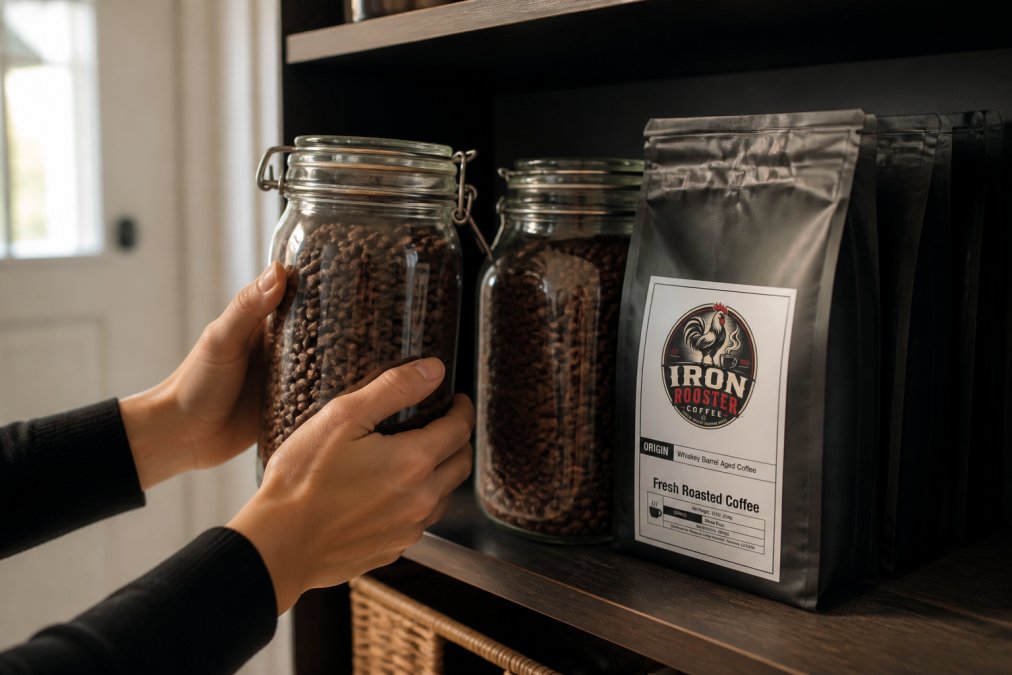
Store coffee beans in an airtight container in a cool, dark place. A sealed glass jar, valve-sealed coffee bag, or ceramic container with rubber gasket works. Cool and dark means a pantry, cabinet, or closet, not above your stove, on a sunny windowsill, or in a warm garage. Temperature stability matters more than absolute temperature.
Do not freeze or refrigerate coffee. Repeated temperature swings create condensation inside the container, introducing moisture that degrades beans faster than oxidation would.
Grind only what you need, right before brewing. Ground coffee has vastly more surface area exposed to oxygen than whole beans and loses most volatile compounds within hours. Buy in quantities you'll use within 3-4 weeks.
Signs of Stale Coffee Beans and What to Avoid
Stale coffee beans have visual, aromatic, and taste signatures that help you avoid wasting money on old coffee.
Visual signs: Fresh roasted beans are uniformly dark brown with a matte finish. Stale beans look dull, faded, or grayish. A silvery sheen indicates beans past their prime.
Aroma: Fresh roasted coffee smells vibrant and complex. Stale coffee smells flat, musty, or one-dimensional.
Lack of bloom: Pour hot water over fresh beans and you see immediate, vigorous bubbling. Pour water over stale beans and there's barely a bubble.
Taste: Fresh roasted coffee tastes clean, bright, and complex. Stale coffee tastes bitter, flat, or muddy.
Avoid: coffee with no roast date, coffee in clear bags, coffee in warm retail displays, pre-ground coffee more than a few days old, and coffee that smells musty or flat.
Cost Analysis: Price Per Cup and What You're Actually Paying For
Fresh roasted coffee costs $18-25 per pound. Grocery store coffee costs $5-12 per pound. A pound of coffee yields roughly 16 cups (usda.gov). At $20 per pound, that's $1.25 per cup. Grocery store coffee at $8 per pound is $0.50 per cup. The difference is $0.75 per cup, or about $15-20 per month for a daily coffee drinker.
That $0.75 difference buys you a cup that tastes dramatically better, brighter, more complex, and less bitter. For someone who drinks coffee every morning, that's a meaningful quality-of-life improvement at modest cost.
What you're paying for:
Bean quality: Specialty roasters source single-origin and specialty-grade beans graded higher, grown at higher altitudes, and processed more carefully than commodity coffee.
Freshness: Fresh roasted coffee is roasted days or weeks before you buy it. Freshness directly affects flavor.
Roasting skill: Specialty roasters develop roast profiles for specific beans, not one-size-fits-all profiles designed for speed.
Traceability: Many specialty roasters know bean sources by name, specific farms, or cooperatives. Commodity coffee is blended so thoroughly that traceability is impossible.
Iron Rooster Coffee Co. prices fresh roasted beans at $20.99 per pound, roasted to order or within days of your order, carefully sourced from specific origins, and shipped fast to preserve freshness.
| Factor | Fresh Roasted | Grocery Store |
|---|---|---|
| Roast Date | Within 1-2 weeks | 2-6 months old |
| Price Per Pound | $18-25 | $5-12 |
| Price Per Cup | $1.10-1.56 | $0.31-0.75 |
| Flavor Complexity | High | Low |
| Freshness Window | 3-4 weeks | Already past peak |
| Bean Grade | Specialty | Commodity |
| Traceability | Known origin | Unknown blend |
| Best For | Flavor enthusiasts | Budget-conscious buyers |
Sourcing, Supply Chain, and Bean Quality Standards
Where coffee comes from and how it gets to you determines quality more than any other factor.
Specialty coffee sourcing: Specialty roasters work directly with farmers, cooperatives, and importers. They visit farms, taste beans, and build relationships. They pay premium prices for premium beans and know the altitude, processing method, and often the specific farmer or cooperative.
Iron Rooster Coffee Co. sources from specific origins: smallholder farmers in Medellin, Colombia; Kintamani, Bali; and Fazenda Santa Barbara in Brazil. Each origin is chosen for its terroir, altitude, soil, climate, and farming practices that create distinct flavor profiles.
Commodity coffee sourcing: Grocery store coffee comes from commodity markets where beans are bought and sold in bulk with no traceability. Beans from multiple origins, harvest years, and quality grades are blended together. The focus is cost, not flavor.
Supply chain speed: Specialty roasters prioritize speed. Beans are roasted to order or in small batches, then shipped within days. Grocery store coffee moves through warehouses, distribution centers, and retail shelves over months.
Quality standards: Specialty coffee is graded by the Specialty Coffee Association (SCA) using a 100-point scale (sca.coffee). Beans scoring 80+ are specialty grade. Grocery store coffee is often commodity grade or ungraded.
Which Option Is Right for You
The choice between fresh roasted coffee and grocery store coffee depends on what you value and how you drink coffee.
Choose fresh roasted coffee if: You drink coffee daily and appreciate flavor complexity. You're willing to spend an extra $0.75-1 per cup for noticeably better taste. You want to know where your coffee comes from. You have a grinder and time to brew properly. You want smooth, flavorful coffee, not harsh or bitter.
Choose grocery store coffee if: You drink coffee occasionally or don't have strong flavor preferences. Budget is your primary concern. You want convenience and don't want to think about roast dates or storage.
For remote professionals and morning-routine focused consumers who appreciate smooth, non-bitter coffee, fresh roasted coffee is almost always the better choice. The flavor difference is dramatic. The cost difference is modest. Direct-to-door delivery eliminates friction in sourcing specialty coffee.
If you're new to specialty coffee, start with a single-origin like our House Blend, a medium roast with notes of nutty, sweet chocolate, mild citrus, and clean bright finish. Then explore single-origins like our Colombia or Brazil Santos to experience how origin affects flavor.

The real difference between fresh roasted coffee and grocery store coffee is the difference between coffee at its best and coffee past its prime. Once you taste fresh roasted coffee, grocery store coffee becomes hard to return to.
Frequently Asked Questions
Is fresh roasted coffee actually better than store-bought?
Yes, fresh roasted coffee delivers noticeably better flavor, aroma, and body than grocery store coffee. Grocery store beans often sit on shelves for weeks or months, causing oxidation and volatile compounds to escape. Fresh roasted beans retain their complex flavor notes, acidity, and sweetness. The difference is most apparent in the first 2-4 weeks after the roast date, when extraction improves and bitterness decreases.
How long does coffee stay fresh after the roast date?
Coffee peaks in flavor 3-10 days after roasting, when degassing is complete and volatile compounds are fully developed. Peak freshness lasts 2-4 weeks. After 4 weeks, oxidation accelerates and flavor notes flatten. Properly stored beans remain drinkable for 6-8 weeks, but quality declines noticeably after the first month. Always check the roast date on your bag, this is more important than a generic expiration date.
What should I look for on a coffee bag label?
Look for a roast date (not a best-by date), single-origin or blend information, tasting notes, altitude, and processing method. A roast date tells you exactly how fresh the beans are. Specialty coffee bags also list the grower, region, and flavor profile. Avoid bags without roast dates or with dates older than 2 months. These details indicate whether you're buying commodity coffee or specialty-grade beans with traceable sourcing.
Why does fresh roasted coffee cost more than grocery store coffee?
Fresh roasted coffee costs more because of sourcing quality, roasting to order, faster shipping, and smaller batch sizes. Specialty beans from single-origin farms cost 2-3 times more than commodity coffee. Roasting to order means beans are roasted days before delivery, not weeks before. Grocery store coffee is roasted in bulk, shipped long distances, and stored for months, a cheaper process that sacrifices flavor. You're paying for freshness, traceability, and superior taste.
Can I adjust my brewing method to make older coffee taste better?
Slightly, but only to a point. Older beans lose volatile compounds and develop stale, flat notes that brewing adjustments cannot fully restore. However, you can improve extraction by using a finer grind, hotter water, or longer steep time. These techniques pull more from the remaining compounds. Fresh roasted coffee still tastes better with the same brewing method, so starting with fresh beans gives you the best foundation for a smooth, flavorful cup.
If you've been buying grocery store coffee out of habit or budget constraint, it's worth trying fresh roasted coffee at least once. Iron Rooster Coffee Co. delivers freshly roasted beans at peak flavor directly to your door, with sourcing you can trust and flavor profiles that make your morning routine genuinely better. Add our House Blend to experience the difference, smooth, complex, and roasted to order for maximum freshness.
This article was written using GrandRanker