

Table of Contents
- Why the Coffee Roast Date Importance Decides Everything
- A 5-Step Freshness Audit for Fresh Coffee Beans
- Signs of Stale Coffee Beans You Should Never Ignore
- How to Order Fresh Roasted Beans Online Without Getting Burned
- Storage and Shelf Life: Keeping Fresh Coffee Beans Fresh
- Frequently Asked Questions
Last Updated: September 10, 2026
Why the Coffee Roast Date Importance Decides Everything
The roast date is the single most reliable indicator of whether you're holding fresh coffee beans or expensive shelf decoration. Coffee begins losing its best qualities within days of roasting, not months, which is why the date printed on the bag matters more than any "best by" label ever will.
Here's the uncomfortable truth most grocery aisles won't tell you: a bag can sit in a warehouse for months before it ever reaches a shelf. At Iron Rooster Coffee Co., we roast to order for exactly this reason.
Fresh coffee beans are beans used within roughly two to six weeks of their roast date, depending on the roast level and storage method. That window is short, and it closes faster than most people expect.
A 5-Step Freshness Audit for Fresh Coffee Beans
You can run a complete freshness check in under five minutes using nothing but your eyes, nose, hands, and a kettle. The five steps below move from least to most conclusive, so if a bag fails early, you already have your answer. Score each step from 0 to 2 and total it at the end, anything under 6 out of 10 means the beans are past their useful window.
Step 1: Visual Inspection and Oil Sheen
Start by looking at the beans themselves. Fresh beans have a matte, dry-looking surface, while older beans often develop a shiny coat as oils migrate to the surface over time. A light oil sheen on a dark roast can be normal, but heavy grease on a medium roast usually signals age or over-roasting.
Check for uniformity too. Consistent color across the batch suggests careful roasting and even bean density. Uneven patches often mean a sloppy roast profile or mixed lots. Score 2 for matte and uniform, 1 for slight sheen, 0 for heavy oil or blotchy color.
Step 2: Aroma and the Olfactory Test
Your nose is a surprisingly accurate freshness gauge. Open the bag and breathe in deeply. Fresh beans release a complex, sweet, almost floral aroma profile with clear origin character.
Stale beans smell flat, papery, or faintly musty, like an old pantry. If you have to work hard to detect anything at all, that's your answer. What most guides miss is that a strong smell isn't automatically a good sign. Freshly roasted beans smell vibrant and layered; burnt-smelling beans are a roast problem, not a freshness win. Score 2 for layered sweetness, 1 for faint or one-note aroma, 0 for papery or musty.
Step 3: Bean Density and Grind Consistency
Heavier, denser beans generally hold their freshness longer because they're more tightly packed and release carbon dioxide more slowly. Pick up a handful and compare the weight against volume. Fresh beans feel substantial; older beans feel light and hollow.
Here's the mechanism most guides skip: as beans degas, the internal cell structure that was pressurized by carbon dioxide during roasting slowly collapses. That loss of internal pressure is why stale beans feel lighter in the hand and why they shatter instead of fracturing cleanly in the grinder. Light roasts are denser and degas more slowly than dark roasts, so a light roast at three weeks can still outperform a dark roast at ten days. Grind consistency tells the same story, fresh beans grind evenly and hold their shape, while stale beans produce more fines and a dusty, uneven result. Score 2 for heavy, even grind; 1 for slightly light or mixed grind; 0 for hollow feel and shattering.
Step 4: The Coffee Bloom Test Explained
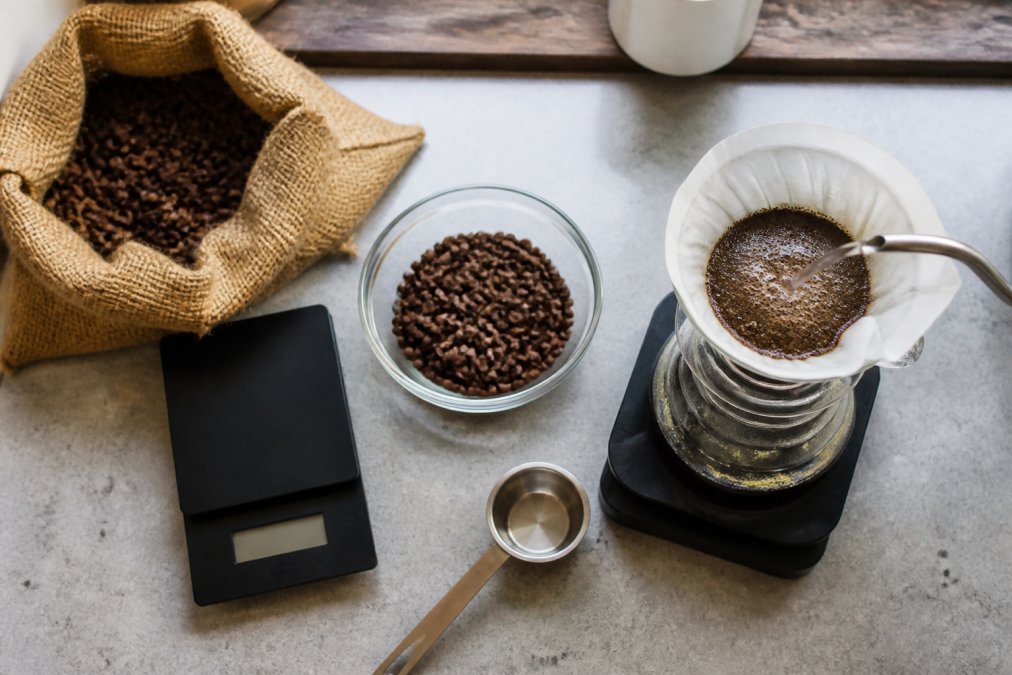
The coffee bloom test explained in one sentence: pour hot water over fresh grounds and watch how much they swell and bubble. Fresh beans release trapped carbon dioxide, or degassing, which creates a visible dome of foam and a satisfying crackle.
To make the test repeatable, standardize it. Use 15 grams of coffee, freshly ground medium, in a pour-over dripper. Heat water to just off boil, around 200 to 205 degrees Fahrenheit, and pour 50 grams of water in a slow spiral (sca.coffee). Start a timer. Watch for three things:
- Dome height: Fresh beans swell into a tall, mounded bed. Stale beans stay flat.
- Bubble activity: A lively crackle and visible CO2 release for 20 to 30 seconds signals active degassing. Quiet, still grounds signal the gas left weeks ago.
- Collapse time: A healthy bloom holds its dome for roughly 30 to 45 seconds before settling. A bloom that collapses in under 15 seconds is a strong staleness signal.
Score 2 for a tall dome with active bubbling past 30 seconds, 1 for a modest bloom that fades quickly, 0 for a flat, lifeless bed.
Step 5: Taste, Crema, and Flavor Clarity
The final and most decisive test is the cup itself. Fresh beans produce flavor clarity, balanced acidity, and a clean finish. Stale beans taste flat, hollow, and slightly cardboard-like no matter how carefully you brew.
Crema matters here too if you pull espresso. A thick, persistent crema points to freshness and proper extraction; a thin, pale layer that vanishes quickly usually means old beans or a stale grind. Score 2 for clear, layered flavor and lasting crema, 1 for muted but drinkable, 0 for flat, papery, or rancid.
Your Freshness Scorecard
Add your five scores together for a quick verdict:
| Total Score | Verdict |
|---|---|
| 9-10 | Peak freshness, brew now |
| 6-8 | Drinkable but fading, finish within a week |
| 3-5 | Past prime, expect flat cups |
| 0-2 | Stale, repurpose or replace |
Re-run the audit every time you open a new bag and jot the date and score on the bag with a marker. Over a few months you'll build a personal freshness curve for each roaster you buy from, which is far more useful than any generic two-to-six-week rule.
Signs of Stale Coffee Beans You Should Never Ignore
Stale coffee announces itself in predictable ways once you know what to look for. The most common signs of stale coffee beans include a dull, matte appearance with no aroma when the bag opens, a flat bloom, and a cup that tastes thin, papery, or faintly rancid.
Other red flags:
- A "best by" date with no roast date printed anywhere on the bag
- Oily, slick beans that feel greasy to the touch
- A musty or cardboard smell instead of sweetness
- Packaging with no one-way valve to release carbon dioxide
- Beans that shatter unevenly in the grinder
If two or more of these show up together, you're almost certainly drinking coffee past its prime. The fix isn't a better brewer. It's better sourcing.
How to Order Fresh Roasted Beans Online Without Getting Burned
The safest way to order fresh roasted beans online is to buy from roasters who print an actual roast date, roast to order, and ship quickly. Skip any listing that only offers a vague "roasted fresh" claim with no date attached.
A few habits separate a good online order from a disappointing one:
- Look for a specific roast date, not just a batch number
- Check whether the roaster ships within days of roasting
- Confirm the bag has a one-way valve for degassing
- Start with a smaller bag if you're testing a new roaster
- Ask about subscription flexibility if you drink slowly
This is where a roaster's process matters more than its marketing. Iron Rooster Coffee Co. roasts to order and ships directly to your door, so the beans arrive close to their roast date rather than after months in a warehouse.
Storage and Shelf Life: Keeping Fresh Coffee Beans Fresh
Storage decides how long your fresh coffee beans stay worth drinking. Whole beans kept in an airtight container away from light, heat, and moisture hold their peak flavor for roughly two to four weeks, while ground coffee fades within days (peer-reviewed research).
What works:
- An opaque, airtight container stored in a cool cupboard
- Keeping beans whole until you brew
- Buying in quantities you'll finish within a few weeks
- Freezing beans in a sealed bag for long-term storage
What doesn't:
- The fridge, which exposes beans to moisture and odors
- A clear jar on a sunny counter
- Pre-grinding a week's worth at once
- Leaving the bag rolled open between uses
One thing most people overlook: the one-way valve on quality bags isn't decoration. It lets carbon dioxide escape during degassing without letting oxygen in, which slows oxidation and protects flavor (PubMed). If your bag lacks a valve, transfer the beans to an airtight container as soon as it's opened.
How to Test Whether Your Storage Actually Works
Most storage advice stops at "use an airtight container" and never asks the obvious follow-up: is your container actually airtight? Here's a simple test you can run in ten minutes with what's already in your kitchen.
The water displacement test. Fill your container with water, seal it, and turn it upside down over a sink for 60 seconds. Any drip, seep, or bubble at the seal means air is moving in and out, and if water can get through, oxygen can too. Dry the container completely before using it for beans.
The smell-transfer test. Place a strongly scented dry good, a cinnamon stick or a few cloves, inside your container, seal it, and leave it on the counter for 24 hours. Open it and smell. If you can detect the spice, the container is porous or the seal is weak, and your beans are picking up whatever's nearby in your cupboard. Glass with a silicone gasket and a clamp lid usually passes; thin plastic and screw-top jars often fail.
The two-bag comparison test. This is the most direct method. Split a fresh bag of beans in half. Store one half in your current container and the other half in the original bag with its one-way valve, sealed with a bag clip. After 10 days, brew both side by side using the same dose, grind, and water. If the container beans taste flatter or duller, your storage is losing the race against the bag you already paid for.
The one-way valve check. If your bag has a valve, press gently on the sealed bag. You should feel air escape through the valve but not be able to push air back in. A valve that lets air both ways is doing nothing for freshness.
| Storage Method | Keeps Beans Fresh For | Best For |
|---|---|---|
| Airtight opaque container, cool cupboard | 2-4 weeks | Daily drinkers |
| Original bag with one-way valve, sealed | 2-3 weeks | Short-term storage |
| Freezer in a sealed bag | 1-2 months | Buying in bulk |
| Refrigerator | Not recommended | Nothing |
Freezing Without Ruining the Beans
Freezing gets a bad reputation because most people do it wrong. The enemy isn't cold, it's moisture and repeated temperature swings. Portion beans into single-week bags, squeeze out as much air as possible, seal them, and freeze. When you're ready to brew, take one portion out and let it come to room temperature before opening the bag. Opening a frozen bag lets condensation form directly on the beans, which is the fastest way to ruin them. Never refreeze a portion you've already thawed.
If you want a starting point that arrives close to roast date, the Whiskey Barrel Aged and Bali Blue single origins are both roasted to order, which means the clock starts when the bag reaches you, not when it left a warehouse.


Frequently Asked Questions
How can you tell if coffee beans are fresh without a roast date?
Without a printed roast date, rely on your senses. Fresh coffee beans feel dense and cool in the hand, smell sweet and roasted rather than papery, and release a visible dome of bubbles when hot water hits the grounds. Oily, shiny beans with a flat or musty aroma are usually past their peak. If the bag has no roast date, batch number, or origin details, treat the coffee as a gamble and buy from a roaster who prints dates on every bag.
Does the bloom test actually prove coffee freshness?
The bloom test is one of the most reliable checks you can run at home. Freshly roasted beans still hold carbon dioxide from roasting, so when hot water hits the grounds, that gas escapes and pushes a bubbly dome upward. A big, active bloom points to recent roasting, usually within two to four weeks. A weak or flat bloom suggests the coffee has already degassed and lost much of its aroma.
What does stale coffee smell like compared to fresh coffee?
Fresh coffee smells sweet, roasted, and layered, with notes that match its origin and roast profile. Stale coffee smells dull, papery, or musty, sometimes with a hint of cardboard or old hay. If you crush a bean and get almost nothing, the volatile oils have oxidized. A quick olfactory test on a small handful of ground beans tells you more in five seconds than any label claim.
How should you store coffee beans to maintain freshness?
Keep beans in an airtight container with a one-way valve, away from light, heat, and moisture. A sealed canister in a cool cupboard works for two to four weeks of daily use. For longer storage, freeze beans in a vacuum-sealed bag and grind them straight from frozen. Avoid the fridge, where moisture and food odors creep in, and never store beans in the hopper of a grinder for weeks at a time.
Judging freshness comes down to five quick checks: look, smell, feel, bloom, and taste. Most people skip straight to taste and blame their brewer when the beans were the problem all along. Iron Rooster Coffee Co. roasts to order so your bag arrives with its best weeks still ahead of it, backed by carefully selected beans, fast automated fulfillment, and delivery straight to your door. Get started with Iron Rooster Coffee Co. and taste what a genuinely fresh roast does for your morning cup.