

Table of Contents
- Medici Roasting vs Fresh Roasted Coffee: The Core Difference
- What Medici Roasting Does Well
- Where Fresh Roasted Coffee Wins
- Coffee Roast Date Importance: Why the Date on the Bag Decides Everything
- The Science of Resting Coffee: Why Freshly Roasted Beans Need Time
- How to Store Fresh Roasted Coffee So It Stays Fresh
- Fresh Roasted Coffee Subscription vs Buying Local
- Cost-Benefit Analysis: Fresh Roasted Coffee vs Grocery Store Bags
- Visual Identification of Stale Beans: What to Look For
- Conclusion
- Frequently Asked Questions
Last Updated: September 15, 2026
Medici Roasting vs Fresh Roasted Coffee: The Core Difference
The gap between Medici roasting and fresh roasted coffee comes down to one variable you can verify before you brew: the roast date printed on the bag. Medici roasting means large batches distributed through retail channels, where weeks or months pass between roaster and kitchen. Fresh roasted coffee is roasted to order and shipped within days, preserving the volatile aromatic compounds that define cup quality. This guide from Iron Rooster Coffee Co. breaks down where each approach wins, and why the roast date matters more than the label.
Three things decide whether your morning cup tastes vibrant or flat: the roast date, how the beans were stored, and how long they rested before brewing. Below, we'll show you how to read those signals, store beans so they stay fresh, and what the real cost difference looks like per cup.
Winner: Fresh roasted coffee for anyone who drinks coffee at home more than twice a week. Medici-style retail roasting wins only on immediate availability and shelf convenience.
What Medici Roasting Does Well
Medici roasting excels at consistency and reach. Large-batch roasting produces a uniform product that tastes the same in every bag, which matters if you value predictability over nuance.
The model solves a real problem: shelf stability. Beans roasted for retail distribution are packaged to survive long transit and extended shelf time, so they arrive drinkable rather than spoiled. For a household that drinks one bag every two months, that reliability has genuine value.
What most guides miss is that this consistency is achieved partly by sacrificing the top notes. A roast profile designed to hold up over months cannot also showcase the delicate fruit or floral characteristics that fade first.
Where Fresh Roasted Coffee Wins
Fresh roasted coffee wins on flavor clarity, aroma, and the sensory experience of the cup. Beans roasted to order and shipped quickly retain the volatile compounds responsible for acidity, sweetness, and aroma (pubmed.ncbi.nlm.nih.gov).
The difference shows up in the first pour. Freshly roasted beans bloom dramatically when hot water hits them, releasing carbon dioxide and carrying aromatic oils into the cup; older beans barely react (pubmed.ncbi.nlm.nih.gov). That bloom confirms the coffee still has something to give.
There is a trade-off. Fresh coffee demands attention: track the roast date, store it properly, and drink it within a reasonable window. Convenience is not the selling point here, quality is.
Coffee Roast Date Importance: Why the Date on the Bag Decides Everything
Coffee roast date importance comes down to this: the roast date is the only reliable indicator of how much flavor remains in the bag. A "best by" date tells you when the roaster thinks the coffee becomes unacceptable, not when it was roasted, and the gap between those numbers is where most grocery-shelf disappointment lives.
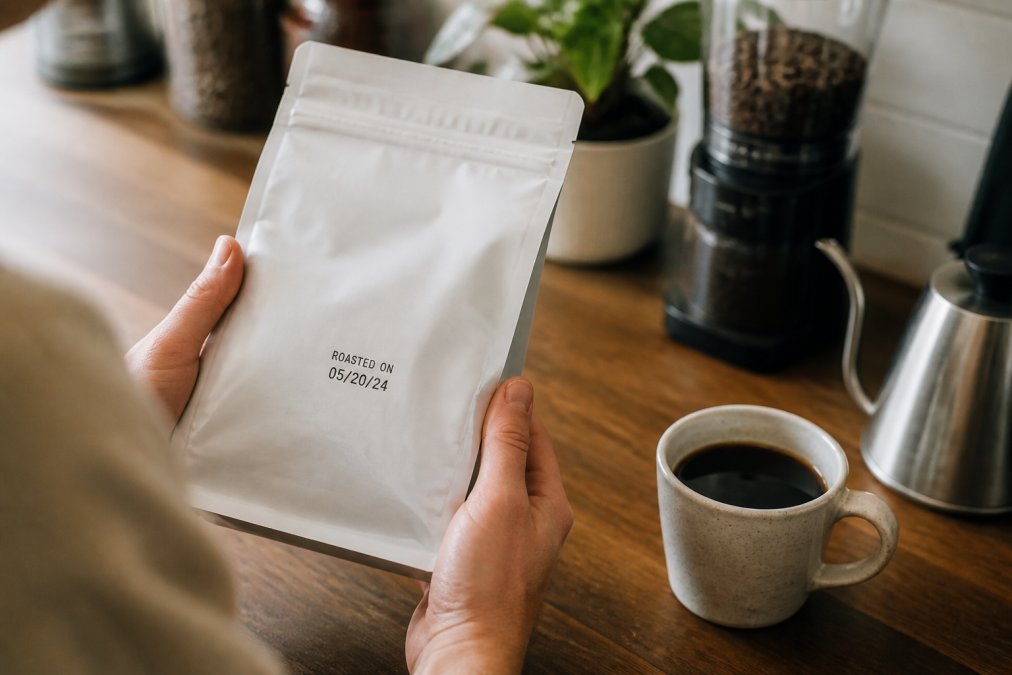
Why the Clock Starts at First Crack, Not at the Store
Flavor loss is not a single event but a set of parallel chemical reactions that begin the moment beans leave the roaster. Three matter most:
- Oxidation: Oxygen attacks aromatic oils on the bean surface and inside the cell structure, converting pleasant volatile compounds into flatter, papery ones, the same reaction that turns cooking oil rancid, just slower and less obvious.
- Volatile loss: The compounds responsible for fruit, floral, and bright acidity notes are the lightest and most fragile. They evaporate or degrade first, which is why a stale bag often still tastes "like coffee" but loses its distinctiveness.
- Moisture migration: Beans slowly exchange moisture with the surrounding air. Even small shifts change how water extracts them, which is why the same bag can brew differently in week one versus week five.
None of these reactions care about the printed expiration date, only time since roast, oxygen exposure, and temperature.
How to Read a Roast Date Like a Pro
Find the actual roast date, not the expiration date, then apply a simple rule of thumb:
- Days 1-3 after roast: Too fresh for most brewing. Carbon dioxide interferes with extraction.
- Days 4-14: Peak window for pour-over and batch brew.
- Days 7-21: Ideal for espresso, which benefits from a short rest.
- Beyond 4-6 weeks: Flavor declines noticeably regardless of packaging.
If a bag lists only a "best by" date, treat that as a warning sign. Roasters confident in their freshness print the roast date.
The Label Signals That Actually Matter
Roast date is the headline, but three other label details change how much freshness survives to your kitchen:
- One-way degassing valve. Fresh beans release carbon dioxide for days after roasting. A valve lets that gas escape without letting oxygen in; a sealed bag with no valve either traps gas (and can balloon) or, if simply folded, offers no oxygen barrier at all.
- Packaging material. Foil-lined or metallized bags with a valve block far more oxygen than paper or thin kraft pouches. If the bag feels like a chip bag, that is a good sign for shelf life; if it feels like a paper sack, drink it fast.
- Roast level. Darker roasts degas and oxidize faster because more of the bean's structure has broken down (pubmed.ncbi.nlm.nih.gov). A dark roast at day 10 is often past its best, while a light roast at day 10 may still be climbing toward peak.
What the Date Cannot Tell You
A roast date is necessary but not sufficient. It cannot tell you how beans were stored between roasting and shipping, whether the bag was opened and resealed in a warehouse, or how long it sat in a hot delivery truck. The date is the starting point for judgment, not the whole judgment.
The Practical Takeaway
For daily drinkers, the roast date is the single most useful number on the bag.
The Science of Resting Coffee: Why Freshly Roasted Beans Need Time
Two Clocks, Not One
Why CO2 Ruins a Brew
How Long to Rest, by Method and Roast
| Method | Typical rest window | Why |
|---|---|---|
| Espresso | 7-14 days | Pressurized extraction amplifies CO2 interference; needs the longest rest |
| Pour-over | 3-7 days | Gentle, even extraction tolerates a shorter rest |
| Batch brew | 4-10 days | Forgiving, but benefits from a few days off the roast |
| Cold brew | 1-3 days | Long steep time and cold water reduce CO2 sensitivity |
How to Tell When Resting Is Done
The Resting Trade-Off
How to Store Fresh Roasted Coffee So It Stays Fresh
The Four Enemies of Freshness
Fresh Roasted Coffee Subscription vs Buying Local
| Factor | Subscription | Local Roaster | Grocery Shelf |
|---|---|---|---|
| Typical time since roast | Days | Days to weeks | Weeks to months |
| Roast date visible | Usually | Usually | Rarely |
| Convenience | High | Depends on location | Highest |
| Cost per bag | $19.99-$20.99 | Varies | Lowest |
| Flavor clarity | High | High if fresh | Low |
Cost-Benefit Analysis: Fresh Roasted Coffee vs Grocery Store Bags
Visual Identification of Stale Beans: What to Look For
Conclusion
Frequently Asked Questions
What's special about Medici coffee?
Medici Roasting built its reputation on cafe culture and espresso drinks, with multiple locations and a focus on the in-store experience. Their beans are roasted in-house and sold through their cafes and online store. The catch is that most bags sit on a shelf or in a warehouse before reaching you, so the roast date may already be a week or two old. For drip coffee at home, that matters more than the brand name.
Is fresh roasted coffee always superior to store-bought options?
Not automatically, but the gap is real. Fresh roasted coffee hits its peak flavor roughly 4 to 14 days after roasting, while grocery store bags often sit for months. Oxidation degrades the aromatic oils that create flavor clarity and sweetness. A well-roasted bean that's three months old will taste flat next to a decent bean roasted last week. The roast date, not the label, tells you which one you're getting.
Why does roast date matter for coffee flavor profiles?
Coffee beans start degassing carbon dioxide immediately after roasting, and that gas affects how water extracts flavor during brewing. Beans rested 4 to 14 days produce a more balanced cup with clearer acidity and sweetness. Past three or four weeks, oxidation takes over and you get bitterness, cardboard notes, and muted aromatics. Checking the roast date before you buy is the single fastest way to predict cup quality.
How does single-origin sourcing affect coffee quality?
Single-origin beans come from one region, farm, or cooperative, so the flavor reflects a specific place rather than a blend designed for consistency. That means more distinctive notes, whether fruity, chocolatey, or floral, but also more variation between harvests. Blends trade that distinctiveness for balance and repeatability. Neither is better; it depends on whether you want a cup that tastes like a region or one that tastes the same every morning.