

Table of Contents
- The Real Reasons Specialty Coffee Costs More
- Commodity vs Specialty Coffee: Where the Money Goes
- How to Identify High-Quality Coffee Beans
- Benefits of Single-Origin Coffee
- How Roasting Technology and Freshness Affect Price
- The Cost of Brewing: What You Actually Pay Per Cup
- Is Specialty Coffee Worth the Premium?
- Frequently Asked Questions
Last Updated: September 11, 2026
The Real Reasons Specialty Coffee Costs More
Specialty coffee costs more because it is grown, picked, processed, and roasted with far more care than commodity coffee, and every step adds real expense. At Iron Rooster Coffee Co., we see this firsthand: a single pound of specialty beans can pass through dozens of hands before it reaches your grinder. The price on the bag reflects all of that work.
Understanding why specialty coffee costs more starts with one uncomfortable fact: most coffee is priced as a global commodity, while specialty coffee is priced as a crafted product. Those two systems barely resemble each other.
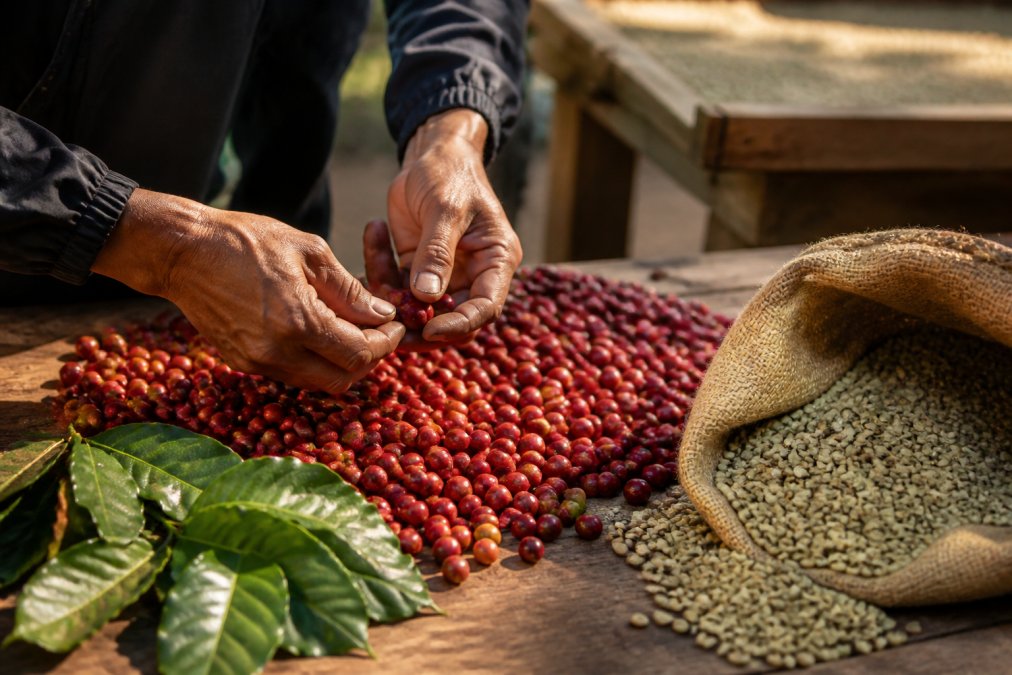
What Sets Specialty Grade Apart
Specialty grade refers to coffee that scores 80 points or higher on a 100-point scale used by professional graders, called cuppers (sca.coffee). Anything below that threshold is classified as commodity or commercial coffee.
That scoring system, maintained by the Specialty Coffee Association's cupping standards, measures flavor, acidity, body, balance, and cleanliness of the cup. A coffee only earns the specialty label after passing strict quality control at multiple stages.
The difference shows up on the farm. Specialty lots are often harvested by hand, with pickers selecting only ripe cherries rather than stripping entire branches. That selectivity is labor intensive, and labor is one of the largest costs in the value chain.
Commodity vs Specialty Coffee: Where the Money Goes
Commodity and specialty coffee follow different pricing paths: commodity trades on global exchanges, while specialty is usually sold through direct roaster-producer relationships. The clearest way to see why the specialty bag costs more is to follow a pound from farm gate to grinder.
The C-Price Problem
The C-price is the benchmark price for commodity coffee traded on futures markets. It moves with global supply, currency shifts, and speculation, not with what it actually costs a farmer to grow a good crop.
When the C-price drops, commodity farmers often sell below their cost of production. Specialty coffee sidesteps this by paying a negotiated farm-gate price reflecting quality, rarity, and the producer's actual expenses. That premium is the first reason a specialty bag costs more.
Where the Money Actually Goes: A Pound-by-Pound Anatomy
To understand the premium, trace a single pound of roasted specialty coffee backward. The exact split varies by origin, lot size, and roaster, but the pattern is consistent:
- Farm gate (green coffee): The largest line item for most specialty lots. Hand-picking, selective harvesting, and small-lot processing push this well above the commodity equivalent.
- Milling and export prep: Dry milling, sorting, grading, bagging, and export documentation. Commodity coffee spreads these costs across enormous volumes; specialty lots absorb them across a few hundred pounds.
- Freight and import: Ocean freight, port fees, customs brokerage, and inland trucking. A pallet of specialty green coffee carries the same fixed import overhead as a container of commodity beans, spread across far fewer pounds.
- Storage and warehousing: Green coffee is stored in climate-controlled warehouses to protect moisture and flavor. Commodity coffee tolerates rougher storage.
- Roasting: Small-batch roasting means smaller charge weights, more sample roasts, more profile development, and more labor per pound. Industrial roasters run continuous batches measured in tons.
- Packaging: One-way degassing valves, foil-lined bags, and small print runs cost more per unit than bulk commercial packaging.
- Distribution and retail: Roast-to-order fulfillment, shipping, and the roaster's margin. Commodity coffee moves through grocery distribution at a fraction of the per-pound handling cost.
Stack those layers and the specialty premium stops looking like a markup and starts looking like a cost structure. The commodity bag is cheap because most of these steps are compressed, outsourced, or eliminated, not because the coffee is worth less.
Direct Trade vs Fair Trade Economics
Fair Trade sets a minimum price floor plus a certification premium, protecting farmers from the worst market swings. Direct Trade goes further: roasters negotiate directly with producers, often paying well above Fair Trade minimums for exceptional lots.
The trade-off is transparency versus overhead. Fair Trade certification costs money and administrative effort some small farms cannot afford. Direct Trade avoids that bureaucracy but depends on trust between buyer and producer. Neither model is free, and both add cost commodity coffee never carries.
The financial mechanics differ in a way that matters to the final price:
- Fair Trade pools risk across a cooperative. The floor protects every member, but the premium is standardized, so a standout lot earns the same as an average one. The cooperative absorbs certification fees, inspection costs, and compliance labor.
- Direct Trade prices the individual lot. A roaster who wants a specific washed Gesha from a specific hillside pays for that specificity, often through multi-year contracts, pre-harvest financing, or above-market fixed prices. The roaster also absorbs travel, relationship management, and quality verification a certification body would otherwise handle.
In practice, most specialty roasters blend the two: Fair Trade or Rainforest Alliance certification for baseline lots, Direct Trade relationships for flagship single origins. Each layer of verification adds a cost the commodity C-price never reflects.
| Model | How Price Is Set | Farmer Protection | Typical Overhead |
|---|---|---|---|
| Commodity | Global C-price | None | Minimal |
| Fair Trade | Minimum floor + premium | Strong | Certification fees, inspection, co-op administration |
| Direct Trade | Direct negotiation | Varies by relationship | Travel, pre-harvest financing, quality verification |
Why This Matters at Checkout
The commodity system optimizes for the lowest price per pound. The specialty system optimizes for quality, traceability, and producer viability, and each goal carries a real cost. When you pay more for a specialty bag, you are paying for a different supply chain with more hands, more checks, and more risk absorbed at every step.
How to Identify High-Quality Coffee Beans
You can identify high-quality coffee beans by looking for a roast date, an origin, a processing method, and a cupping score or grade on the label. Vague packaging with no harvest or roast information is a warning sign.
Here is a quick checklist to run through before you buy:
- Roast date printed, not just a "best by" date
- Specific origin listed, not a vague regional blend
- Processing method named (washed, natural, honey)
- Grade or cupping score mentioned
- Whole bean rather than pre-ground
- Roaster willing to share farm or producer details
A common mistake is buying beans with only a "best by" date. Coffee does not spoil like milk, but it goes stale, and a "best by" stamp tells you nothing about when it was roasted.
Benefits of Single-Origin Coffee
Single-origin coffee comes from one specific farm, region, or cooperative, so its flavor reflects that exact place rather than a blend designed for consistency. The benefits of single-origin coffee include clearer flavor notes, better traceability, and a more direct connection to the producer.
Traceability matters because it supports the price transparency specialty coffee depends on. When you know exactly where a bean came from, you can verify the farmer was paid fairly, central to the whole value chain.
Blends have their place, especially for a smooth, balanced morning cup. But single-origin lots let you taste the difference that climate, altitude, and processing make. That variety is part of what you pay for.
How Roasting Technology and Freshness Affect Price
Roasting technology and freshness affect price because small-batch roasting demands skilled labor and precise equipment, and freshly roasted coffee must move quickly before it stales. Both raise the cost per bag.
A roasting profile is the combination of time and temperature a roaster uses to develop a bean's flavor. Getting it right takes calibration, sample roasts, and often several failed attempts before a lot is dialed in. Large commercial operations roast in enormous batches to spread that cost thin; small-batch roasters cannot.
Freshness adds another layer. Coffee is best within weeks of roasting, so roasters who ship to order cannot warehouse inventory cheaply. They roast, pack, and ship fast, which costs more than letting bags sit in a distribution center.
The Cost of Brewing: What You Actually Pay Per Cup
The cost per cup of specialty coffee is usually far lower than people assume, and the gap narrows further when you compare it against what most households spend on coffee. This is the breakdown most price comparisons skip, and the strongest argument for the specialty premium.
The Math on a Bag
Start with a standard 12-ounce bag, roughly 340 grams of roasted coffee. At a typical drip dose of about 18 grams per cup, that is roughly 18 to 19 cups per bag. A 15-gram dose stretches it to about 22 cups.
Here is how that plays out across price tiers:
- Commodity grocery coffee: Often priced in the low teens per 12-ounce bag. At 18 grams per cup, that lands in the range of well under a dollar per cup.
- Mid-tier specialty: Commonly in the high teens to low twenties per 12-ounce bag. Per cup, that is still typically under two dollars.
- Premium single-origin or micro-lot: Often in the twenties to low thirties per 12-ounce bag. Per cup, still usually under two dollars at standard doses.
The sticker price difference between a commodity bag and a premium specialty bag can look like a 50-100% jump. Spread across 18 cups, the per-cup difference is often cents, not dollars.
The Cafe Comparison
A coffee-shop latte or pour-over typically runs several dollars per drink. Even a basic cafe drip usually costs more per cup than brewing the same specialty beans at home. That gap is the real "cost of brewing" argument: the specialty premium at retail is small relative to the markup you pay for someone else to brew it.
What the Per-Cup Math Includes, and Excludes
The per-cup figure above covers only the coffee itself. A complete home-brewing cost picture also includes:
- Brewing equipment amortized over its lifespan: A drip machine, pour-over setup, or espresso machine spread across hundreds or thousands of cups.
- Filters and consumables: Paper filters, water filters, and cleaning supplies.
- Water and energy: Heating water and running the brewer.
- Milk, sweetener, or additives: If you drink lattes or flavored coffee at home.
Even after those line items, home-brewed specialty coffee typically lands well below the cafe equivalent. Equipment is the largest variable, and it drops toward zero per cup the longer you own the gear.
Why the Per-Cup Frame Changes the Decision
Most people evaluate coffee at the bag level, where the specialty premium looks steep. At the cup level, how you actually consume it, the premium shrinks to a few cents per morning. That is why the specialty-versus-commodity comparison misleads when it stops at the shelf.
A Practical Way to Test It
To see the per-cup math yourself, pick one specialty bag and one commodity bag, brew both at the same dose, and track how many cups each yields. Most drinkers find the specialty bag delivers a noticeably better cup at a per-cup cost that is easy to justify once the number is on paper. That is the honest version of the "is it worth it" question, not the shelf price, but the cup price.
Is Specialty Coffee Worth the Premium?
Specialty coffee is worth the premium if you drink it regularly and care how it tastes. The per-cup math makes the extra cost modest, and the difference in flavor, freshness, and farmer compensation is real.
Where it falls short: if you load your coffee with sugar and cream, or drink one cup a week, the subtle flavor differences may not justify the price. Be honest about your habits before committing.

For most daily drinkers, the value is clear: a smoother, less bitter cup, support for better farming practices, and none of the stale, flat taste of commodity beans that have sat on a shelf for months.
If you want to test the difference without overcommitting, start with a small-batch single-origin like our Whiskey Barrel Aged, a Guatemalan single origin aged 30 days in a bourbon barrel and roasted to order. At $20.99, it is a low-risk way to see what careful roasting actually delivers. For something a little different, our Coffee with Mushrooms Dark Roast blends specialty-grade beans with Lion's Mane, Cordyceps, and Reishi for $19.99.

USDA coffee market and trade data
Frequently Asked Questions
Why is specialty coffee more expensive than commodity coffee?
Specialty coffee costs more because it involves higher farm-gate prices, selective harvesting, careful processing, and rigorous quality control. Farmers are paid a premium for cherries that meet specialty grade standards, typically scoring 80 or above on the 100-point cupping scale. Commodity coffee trades on the C-price, which often sits below the cost of production. The extra steps in traceability, small-batch roasting, and freshness also add to the final price you pay.
How do fair trade and direct trade impact the cost of coffee?
Fair trade certification sets a minimum price floor and a social premium, which raises costs compared to uncertified commodity coffee. Direct trade often goes further by paying farmers above fair trade rates in exchange for consistent quality and long-term relationships. Both models add to the wholesale price because they build in economic viability for the farm. That premium is one reason specialty coffee costs more at retail, but it also supports supply chain stability.
Is specialty coffee worth the higher price point?
For many drinkers, yes. Specialty coffee delivers a smoother, more flavorful cup because beans are selected for quality, roasted in small batches, and shipped fresh. When you break down the cost of brewing, a $20 bag of specialty beans often works out to $1 to $2 per cup, which is far less than a coffee shop drink. The benefits of single-origin coffee, like clearer flavor notes and traceability, add value that commodity coffee rarely matches.
What factors contribute to the price of artisan coffee beans?
Artisan coffee beans carry costs from every stage: labor-intensive harvesting, processing methods like washed or natural, quality control through cupping scores, roasting profile development, packaging, and logistics. Climate change and market volatility also pressure yields and farm-gate prices. Small-batch roasting adds another layer because it requires more attention per pound. Together, these factors explain why specialty coffee costs more than mass-market alternatives.
The challenge with specialty coffee is simple: most people never taste it at its best, because stale beans and poor storage hide what they paid for. Iron Rooster Coffee Co. exists to close that gap. We roast to order, select beans with care, and deliver straight to your door with fast, automated fulfillment, so every bag arrives fresh and every cup tastes the way it should. Explore our single-origin and flavored blends and see the difference for yourself.